Discover Your Vagus Nerve
Discover the Vagus nerve, your body's ancient inner pathway to stillness. Learn how toning this remarkable nerve can quiet mental noise, drop you out of your head and into your body, and open a clearer, more effortless channel to your own deep intuition
There is something quietly miraculous about the Vagus nerve
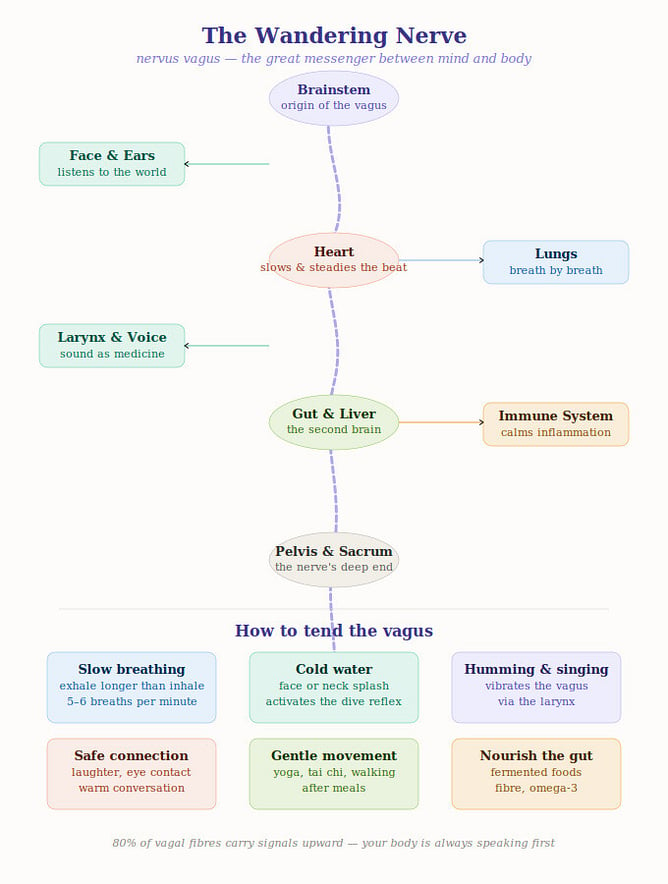
Ancient in its design, it wanders (vagus is Latin for ‘wandering’) from the base of your skull all the way down through your throat, chest, and belly, touching your heart, your lungs, your gut, and beyond.
It is the great internal diplomat, forever carrying messages between your brain and body in both directions, though most of its traffic flows upward: your body reporting in, not the other way around.
Think of it as the conductor of your parasympathetic nervous system - the part of you that exhales, digests, repairs, and rests.
When it is well-toned and flowing, you feel that sense of being grounded and open at the same time.
Calm but present. Safe in your own skin.
The Journey of the Vagus
The Vagus nerve does not travel in a straight line. It meanders, branches, listens.
Here is the path it walks through you -
Brainstem - the origin
It emerges from the medulla oblongata, the most ancient part of your brain, carrying the accumulated wisdom of millions of years of vertebrate evolution.
Face and Ears - listening to the world
Branches reach the muscles of your face and the skin around your ear.
This is why a gentle touch on the ear can calm you, and why the tone of a warm voice can soothe your nervous system before a word is even processed.
Heart - slowing and steadying
The Vagus is the primary brake on your heart rate.
When it is active, your heart slows. This is the physiological foundation of feeling safe.
Heart rate variability - a measure of how fluidly your heart responds to breath, is one of the best indicators of vagal tone.
Lungs - breath by breath
Each breath is a conversation with the Vagus nerve.
Inhalation slightly withdraws vagal influence; exhalation amplifies it. This is why a long, slow exhale is one of the fastest ways to shift your state.
Larynx and Voice - using Sound as medicine
The Vagus threads through your larynx, which means humming, chanting, gargling, or singing literally vibrates the nerve into calm.
Many ancient traditions seem to have known this without ever naming it.
Gut and Liver - your second brain
Your gut contains its own vast web of neurons - the enteric nervous system, sometimes called the second brain. The Vagus is the long bridge between these two minds.
When your gut is distressed, your mind knows. When your mind is calm, your digestion flows.
Your Immune System - calming inflammation
Perhaps its most mysterious role: the Vagus nerve carries signals that actively suppress inflammation throughout the body.
Chronic stress suppresses Vagal tone - chronic inflammation often follows.
The connection runs deep.
How to nourish your healthy Vagus Nerve
What is remarkable is how many simple, everyday things nourish this nerve.
These are not exotic interventions, they are things humans have always done, now understood through a new lens.
Using your Breath - the most direct key
A slow, extended exhale sends a clear signal to the Vagus that you are safe.
Five or six full breaths per minute, where the out-breath is longer than the in-breath, is one of the most potent and portable tools you carry.
In yogic traditions, it's called ‘conscious breathing’.
Try 'conscious breathing' - inhale for 2,3 or 4 counts, exhale slowly for 4,6 or 8 counts
Box breathing - 4 counts in, hold 4, out 4, hold 4; Used by the Navy SEALs to regulate under pressure
Simply sigh - a long, audible exhale resets the nervous system almost instantly.
Sound and Vibration
The Vagus threads through your larynx. Vibrating it with sound is one of the most ancient and underappreciated forms of self-regulation.
Humming - even a few minutes of quiet humming measurably shifts your state
Gargling with water - activates the same vagal branches as singing
Singing and chanting - group singing in particular amplifies the effect through social resonance.
Cold water
Splashing cold water on your face triggers the dive reflex - an immediate, almost oceanic slowing of the heart governed by the Vagus.
Brief cold exposure activates what is called the vagal brake.
Face splash - cold water on face and neck for 30 seconds, especially effective after stress
Cold shower finish - 30–60 seconds of cold at the end of a warm shower
Safe Connections
Genuine human warmth - a real laugh, a lingering eye-to-eye moment - tones the nerve just as surely as any physical practice.
Eye contact and warm conversation - the social engagement system and the vagus are deeply intertwined
Laughter - genuine laughter is one of the fastest vagal activators known
Physical safety cues - slow speech, soft prosody, open posture, all signal safety to another's nervous system.
Gentle Movements
The Vagus responds beautifully to slow, rhythmic movement, especially practices that pair movement with conscious breath.
Yoga and tai chi - particularly postures that open the chest and throat
Walking after meals - gentle movement activates the gut-vagal connection and aids digestion
Slow rocking - an instinctive human self-soothing movement. We do it for babies and ourselves.
Nourish your gut
The gut-Vagal axis means that what you feed your microbiome speaks directly to your nervous system. This is not metaphor, it is biochemistry.
Fermented foods: Yoghurt, kefir, kimchi, sauerkraut all feed the gut bacteria that produce vagal signalling molecules
Fibre and polyphenols: Found in vegetables, berries, and legumes, fuel for a calm, well-communicating gut
Omega-3 fatty acids: Oily fish, flaxseed, and walnuts, all support both vagal tone and reduce neuroinflammation.
A closing reflection
The Vagus nerve is a reminder that you are not a head carrying a body around. You are a whole, breathing, feeling system, and the body has been quietly trying to tell the brain this for a very long time.
80% of aVgal fibres carry signals upward, from body to brain.
Your nervous system is not a one-way broadcast from mind to matter. It is a conversation, ancient and ongoing, and every exhale, every hum, every warm glance across a room is a word in that conversation.
Tend it gently. It has been tending you all along.